
In today’s digital world, new slang terms appear almost every day. From TikTok comments to Snapchat messages and Instagram captions, internet users constantly create shorter and faster ways to express emotions. One slang term that has become increasingly popular is GMFU.
If you’ve recently come across this acronym and wondered about the gmfu meaning in text, you’re not alone. Many people search for what does gmfu mean in text, what does gmfu mean, and gmfu meaning text because the phrase can carry different emotions depending on the context.
This guide explains everything you need to know about GMFU, including its meaning, origin, emotional tone, examples, common misunderstandings, and how people use it across different social platforms.
GMFU – Quick Meaning
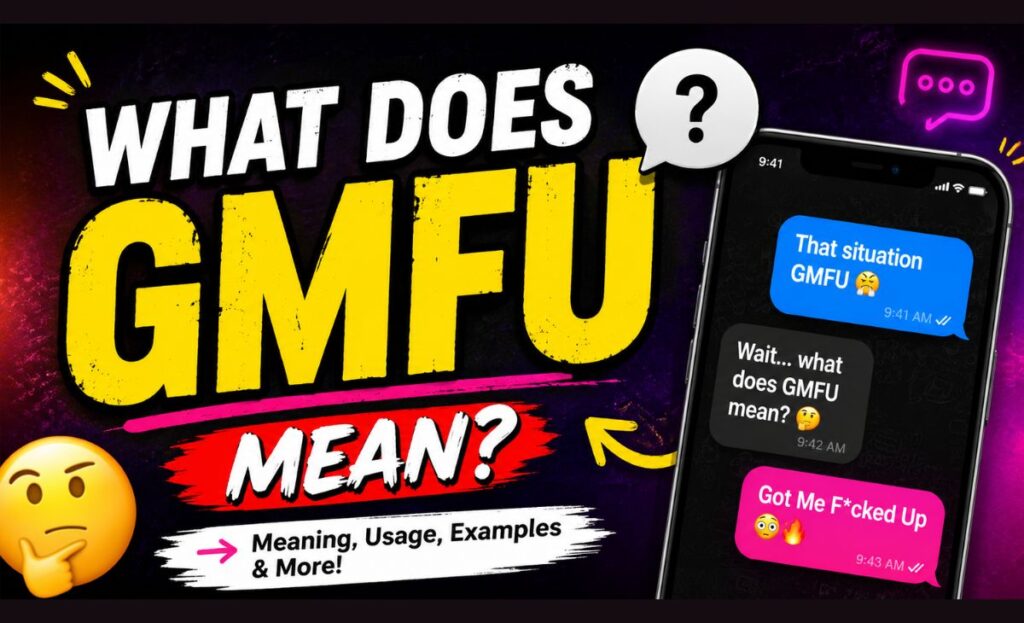
The most common GMFU meaning in text is:
GMFU = “Got Me F*cked Up”
People use this phrase when they feel:
- Shocked
- Frustrated
- Disrespected
- Confused
- Offended
- Surprised
The expression is usually a reaction to something unexpected or unreasonable.
Simple Examples
“You think I’m paying for everyone? GMFU.”
“They moved the exam to tomorrow? GMFU.”
“She won the lottery twice? GMFU.”
In all these examples, the speaker is expressing disbelief or frustration.
So, if you’re asking what does gmfu mean in text, the answer is that it is an emotional reaction phrase used to show strong feelings about a situation.
Origin & Background
To fully understand what does gmfu mean, it helps to know where the phrase came from.
The full phrase “You got me f*cked up” has been used for decades in street slang and everyday conversations. It became especially popular through:
African American Vernacular English (AAVE)
Hip-hop culture
Rap music
Internet forums
Social media platforms
As texting became more common, people shortened the phrase into the acronym GMFU to communicate faster.
Timeline of GMFU’s Popularity
| Period | Development |
| 1990s | Phrase commonly used in urban slang and rap lyrics |
| Early 2000s | Appeared on forums and online chat rooms |
| 2010s | Spread across Twitter, Instagram, and Snapchat |
| 2020s | Became mainstream through TikTok memes and viral videos |
Today, GMFU is widely recognized among Gen Z and Millennials as part of everyday internet language.
Real-Life Conversations
Seeing GMFU in the wild makes its meaning click faster than any definition. Here are examples across different platforms and tones:
Text Message , Frustration:
Person A: “My landlord just raised my rent by $400 with two weeks’ notice.” Person B: “GMFU. That’s actually insane.”
Instagram DM , Shock:
Person A: “She showed up to the interview an hour late and then asked for a raise.” Person B: “Wait… GMFU 😭”
TikTok Comment , Humorous Disbelief:
Video caption: “When your Wi-Fi goes out right before the season finale drops” Top comment: “GMFU every single time 💀”
Group Chat , Sarcastic:
“They cancelled the concert AGAIN. GMFU at this point.”
Positive Context (rare but real):
“Just got accepted into my dream school. Honestly GMFU , didn’t see that coming at all.”
Notice how the emotional weight shifts depending on context. The core meaning , something has disrupted your mental state , stays consistent, but whether that disruption is funny, infuriating, or surprisingly joyful depends entirely on the situation.
Emotional & Psychological Meaning
GMFU isn’t just slang , it’s emotional compression. In a world where people communicate at rapid speed through short messages, the ability to convey a layered emotional response in four characters is genuinely valuable.
When someone uses GMFU, they’re typically communicating one or more of the following:
Disbelief , “I genuinely cannot process this right now.”
Frustration , “This situation has gotten under my skin.”
Shock , “That came completely out of nowhere.”
Emotional overwhelm , “I don’t even know how to respond to this.”
Playful exaggeration , “This is so ridiculous I have to laugh.”
Psychologically, slang like GMFU serves a social bonding function. When someone uses it and the recipient understands it, there’s an instant sense of shared language and cultural familiarity. It signals: we’re on the same wavelength. That sense of in-group belonging is part of why internet slang spreads as fast as it does , especially among Gen Z and younger millennials who grew up with texting as a primary communication channel.
It also functions as emotional shorthand , a way to avoid lengthy explanations. Instead of typing out “I’m genuinely frustrated and taken aback by this situation,” you type GMFU and move on. The emotion lands, the conversation continues.
Usage in Different Contexts
Knowing what does GMFU mean is only half the equation , knowing when and where to use it matters just as much.
Social Media
Instagram: Appears in captions, comment threads, and DMs. Especially common when reacting to surprising news, dramatic posts, or outrageous behavior.
TikTok: Used in video captions, duet reactions, and comment sections. Often paired with emojis like 💀, 😭, or 🤯 to amplify the tone.
Twitter/X: Appears in replies and quote-tweets when reacting to viral moments, hot takes, or breaking news that genuinely floors the writer.
Snapchat & WhatsApp: Used in private chats and group conversations for real-time reactions to things friends share.
When It Works Best
Casual conversations with friends or close contacts
Reacting to something genuinely surprising or absurd
Informal social media comments and captions
Humorous or sarcastic moments where you want to signal exaggerated disbelief
When to Avoid It
Professional emails or workplace communication
Formal settings of any kind
Conversations with older adults who may not recognize the term
Contexts where profanity , even implied , could be offensive or inappropriate
Common Misunderstandings
GMFU trips people up more than you’d expect. Here are the most frequent mistakes:
1. Thinking it’s always negative. While GMFU usually expresses frustration or shock, it can be used playfully or even positively when something overwhelmingly good happens.
2. Assuming it’s aggressive. Context and tone matter enormously. Among friends, GMFU is often casual or even comedic. It doesn’t automatically signal conflict.
3. Confusing it with a greeting. Some people briefly wonder if GMFU is related to “Good Morning” , it’s not. The G doesn’t stand for Good here.
4. Taking it too literally. It’s a figurative expression. No one is claiming to be physically harmed. It simply means: this has disrupted my mental or emotional state.
5. Overusing it. Like any strong phrase, GMFU loses its impact with overuse. Reserve it for moments that actually warrant a strong reaction.
Comparison Table
| Acronym | Full Meaning | Emotional Tone | Intensity Level |
| GMFU | Got Me F*cked Up | Shock, frustration, disbelief | High |
| WTF | What The F*ck | Surprise, anger, confusion | High |
| SMH | Shaking My Head | Mild disappointment, disbelief | Medium |
| FML | F*ck My Life | Self-directed frustration | High |
| ISTG | I Swear To God | Emphasis, frustration | Medium–High |
| NGL | Not Gonna Lie | Honesty marker | Low–Medium |
| IKR | I Know Right | Agreement, shared feeling | Low |
GMFU sits in a specific emotional lane , more intense than SMH or NGL, comparable to WTF in force, but more emotionally personal than either. Where WTF often points outward at a situation, GMFU emphasizes the internal effect that situation has had on you.
Variations / Types of GMFU Usage
Slang rarely stays static, and GMFU has evolved with its users. Here are the main variations you’ll encounter:
1. Straight GMFU The classic, no-frills usage. Expresses frustration or shock directly.
“She said that to your face? GMFU.”
2. GMFU + Emoji Pairing GMFU with 💀, 😭, or 🤯 softens or amplifies the tone, often signaling that the reaction is more humorous than genuinely angry.
“This homework due at midnight GMFU 💀”
3. Lowercase “gmfu” Lowercase often signals a more casual, self-aware, or ironic tone , less heated, more weary.
“three meetings before 9am… gmfu”
4. Extended: “that really GMFU” Adding context around it emphasizes the specific cause of the reaction.
“That plot twist really GMFU, didn’t see it coming at all.”
5. Positive GMFU Used when something overwhelmingly good happens , surprise success, unexpected good news.
“Got promoted out of nowhere. GMFU honestly 😭”
How to Respond When Someone Uses GMFU
Getting a message with GMFU and not knowing how to reply? Here’s a simple framework:
Step 1: Read the tone. Is there humor in the message? Emoji? Or is it a dry, flat response? That tells you whether this is a vent or a joke.
Step 2: Match the energy. If they’re being funny, respond in kind. If they’re genuinely frustrated, acknowledge it.
Responses for frustrated GMFU:
“That’s actually wild, what happened?”
“Okay wait, tell me everything.”
“That’s so wrong, I’m sorry.”
Responses for funny/exaggerated GMFU:
“lmao same honestly”
“Right?? GMFU too 💀”
“The audacity 😭”
Responses for positive GMFU:
“LETS GOOO that’s huge!!”
“You deserved it honestly!”
The golden rule: don’t overthink it. GMFU is casual by nature , match that energy and you’re good.
Regional & Cultural Usage
While what does GMFU mean stays consistent across platforms, how frequently and naturally it’s used does shift by region and cultural context.
United States: GMFU sees the heaviest usage here, particularly in urban areas and among communities closely connected to hip-hop culture. Its AAVE roots mean it’s most organically used in these communities, though it has long since spread beyond them.
UK & Australia: Usage exists but tends to be slightly more restrained. American slang travels quickly through social media and streaming culture, so younger audiences in both countries are familiar with GMFU and use it, though often with a slightly more deliberate or ironic tone.
Global Gen Z Communities: Thanks to TikTok and Instagram, GMFU has become genuinely global. Non-native English speakers in Europe, Asia, and Latin America recognize and use it as part of broader internet English , the informal digital dialect that transcends national borders.
Generational Divide: GMFU is primarily a Gen Z and younger millennial term. Older millennials may recognize it; Gen X and above are less likely to either recognize it or reach for it naturally in conversation. This isn’t a hard rule , anyone can learn slang , but it’s worth being aware of when deciding whether to use it.
FAQ’s
What does GMFU mean in text?
GMFU means “Got Me F*cked Up” , a slang expression for shock, disbelief, or frustration used in texting and social media.
Is GMFU always negative?
Not always. While it usually signals frustration or disbelief, it can be used humorously or even to react to unexpectedly good news.
Where did GMFU come from?
It originated in African American Vernacular English (AAVE) and was popularized through hip-hop culture and early social media platforms in the mid-to-late 2000s.
Can I use GMFU at work?
No. It contains implied profanity and is strictly informal slang , keep it out of professional emails, meetings, or workplace communication.
What’s the difference between GMFU and WTF?
Both express strong reactions, but GMFU emphasizes the personal, internal effect on the speaker, while WTF tends to point outward at the situation itself.
Is GMFU still popular in 2026?
Yes. While slang trends shift constantly, GMFU remains widely recognized and actively used across TikTok, Instagram, and texting among younger demographics.
Can GMFU be used sarcastically?
Absolutely. Sarcastic and ironic usage is actually very common, especially online where exaggeration is part of the communication style.
Conclusion
If you’ve been wondering what does gmfu mean in text, the answer is simple: GMFU usually stands for “Got Me F*cked Up.” It is a popular internet slang term used to express shock, frustration, disbelief, annoyance, or feeling disrespected.
The gmfu meaning in text can change slightly depending on tone and context. Sometimes it is serious, sometimes humorous, and sometimes simply a dramatic reaction to everyday situations. Thanks to TikTok, Instagram, Snapchat, and online culture, the phrase has become a common part of modern digital communication.
Understanding what does gmfu mean, when to use it, and when to avoid it can help you communicate more effectively and stay current with evolving internet slang.

I am David Smith, a passionate blogger and skilled writer. I create clear, engaging, and high-quality content on different topics. I focus on delivering useful and easy-to-understand articles for my readers.