
When someone shares bad news, a workplace challenge, or a personal difficulty, your response matters. While “I am sorry to hear that” is a polite and widely accepted phrase, using it repeatedly can sound repetitive or generic.
Whether you’re writing a professional email, responding to a colleague, supporting a client, or showing empathy in business communication, knowing another way to say sorry to hear that can help you sound more thoughtful and professional.
In this guide, you’ll learn the best professional alternatives to “I am sorry to hear that,” when to use them, and how to choose the right response for different situations.
What Does “I Am Sorry to Hear That” Mean?
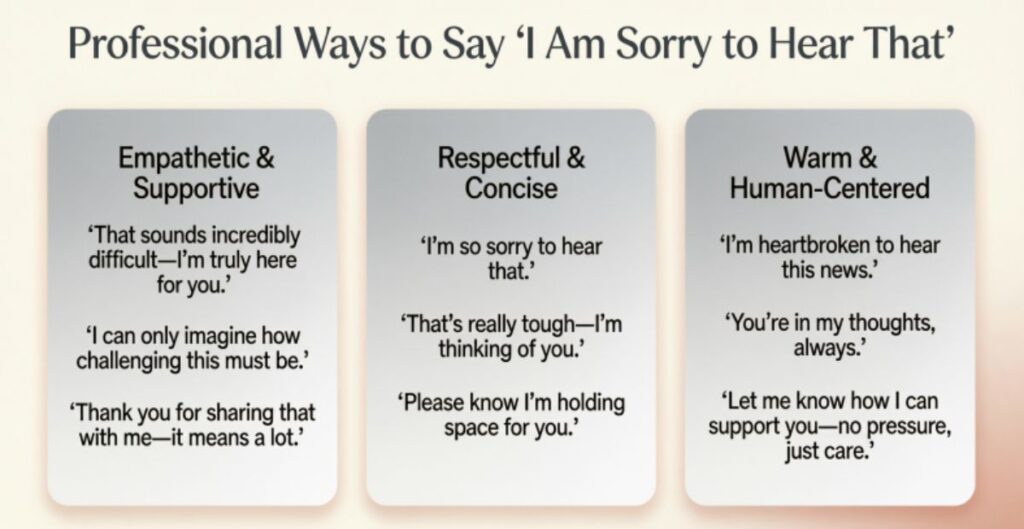
The phrase “I am sorry to hear that” is used to express sympathy, concern, or empathy when someone shares unfortunate news.
It does not necessarily mean you’re apologizing. Instead, it shows that you acknowledge the person’s situation and understand that it may be difficult or upsetting.
Example
Employee: “Unfortunately, my flight was canceled, so I’ll be late tomorrow.”
Manager: “I’m sorry to hear that. I hope everything works out smoothly.”
In professional communication, understanding the sorry to hear that meaning helps you choose more appropriate and context-specific responses.
When to Use It
You can use this phrase when:
- A colleague shares personal difficulties
- A customer reports a problem
- Someone experiences a setback
- A client mentions a challenge
- A team member faces unexpected circumstances
- Responding to disappointing news
It’s particularly useful when you want to acknowledge someone’s situation before offering help or solutions.
Is It Polite or Professional?
Yes. “I am sorry to hear that” is both polite and professional.
However, depending on the situation, a more tailored response may sound more sincere and engaging. In customer service, leadership roles, and professional emails, using an i am sorry to hear that professional way can demonstrate stronger emotional intelligence and communication skills.
37+ Professional Alternatives to “I Am Sorry to Hear That”

Below are 33 carefully selected phrases, each with its meaning, tone, and a real-world example to help you apply it naturally.
1. Thank you for letting me know
Meaning: Acknowledges the information politely while expressing gratitude for the update.
Tone: Professional, neutral
Example: “Thank you for letting me know about the shipping delay, I’ll look into it right away.”
Best for: Client updates, workplace notifications, email responses
2. I appreciate you sharing this with me
Meaning: Conveys genuine gratitude for the person’s openness and trust.
Tone: Warm, professional
Example: “I appreciate you sharing this with me, it gives me a much better understanding of the situation.”
Best for: Performance conversations, feedback sessions, client calls
3. That sounds challenging, thank you for updating me
Meaning: Acknowledges difficulty while expressing appreciation for being kept informed.
Tone: Empathetic, professional
Example: “That sounds challenging, thank you for updating me on the timeline changes.”
Best for: Project management, team check-ins, client communications
4. I’m sorry you’re dealing with this
Meaning: Expresses genuine regret that the person is in a difficult situation.
Tone: Warm, sincere
Example: “I’m sorry you’re dealing with this, please know I’m here to help however I can.”
Best for: Personal hardships, workplace stress, customer service
5. I understand how difficult this must be
Meaning: Shows empathy by acknowledging the emotional weight of the situation.
Tone: Compassionate, professional
Example: “I understand how difficult this must be, especially given the timeline you’re working with.”
Best for: HR conversations, leadership communication, client empathy
6. I’m sorry this happened
Meaning: A direct, sincere acknowledgment of an undesirable event.
Tone: Straightforward, genuine
Example: “I’m sorry this happened, let’s figure out the best way to move forward together.”
Best for: Addressing mistakes, product issues, unexpected setbacks
7. That must be frustrating
Meaning: Validates the person’s emotional response to their situation.
Tone: Empathetic, relatable
Example: “That must be frustrating, especially after all the effort your team put in.”
Best for: Customer complaints, colleague venting, performance setbacks
8. I can only imagine how stressful that is
Meaning: Expresses understanding without claiming to fully grasp the person’s experience.
Tone: Humble, empathetic
Example: “I can only imagine how stressful that is with the deadline approaching.”
Best for: High-pressure situations, workload challenges, personal difficulties
9. I’m sorry you’re experiencing this issue
Meaning: Acknowledges the problem directly, especially in service-related contexts.
Tone: Professional, solution-oriented
Example: “I’m sorry you’re experiencing this issue, I’d like to resolve it as quickly as possible.”
Best for: Customer service, IT support, product teams
10. Thank you for bringing this to my attention
Meaning: Shows appreciation for being informed and implies prompt action.
Tone: Professional, attentive
Example: “Thank you for bringing this to my attention, I’ll have our team look into it today.”
Best for: Formal emails, manager responses, business correspondence
11. I’m sorry things turned out this way
Meaning: Expresses regret about an outcome without assigning blame.
Tone: Neutral, empathetic
Example: “I’m sorry things turned out this way, it wasn’t the result any of us were hoping for.”
Best for: Project closures, contract losses, unexpected decisions
12. I’m sorry for the inconvenience this caused
Meaning: Acknowledges that the issue has disrupted the person’s plans or experience.
Tone: Formal, polite
Example: “I’m sorry for the inconvenience this caused, we’ll make sure it doesn’t happen again.”
Best for: Business emails, customer service, vendor communications
13. I’m sorry you had to go through that
Meaning: Empathizes with the emotional experience, not just the outcome.
Tone: Warm, human
Example: “I’m sorry you had to go through that, it sounds like it was genuinely overwhelming.”
Best for: Personal conversations, HR discussions, team support
14. I understand why this would be upsetting
Meaning: Validates the person’s emotional reaction as reasonable and understandable.
Tone: Calm, professional
Example: “I understand why this would be upsetting, and I want to make sure we address it properly.”
Best for: Conflict resolution, client dissatisfaction, leadership communication
15. I’m sorry you’re facing this situation
Meaning: Shows support without minimizing or dramatizing the issue.
Tone: Sincere, measured
Example: “I’m sorry you’re facing this situation, is there anything I can do to support you right now?”
Best for: Colleague support, performance reviews, client empathy
16. That sounds really tough
Meaning: A more conversational phrase that acknowledges difficulty warmly.
Tone: Informal, human
Example: “That sounds really tough, I hope things start to ease up for you soon.”
Best for: Casual workplace chats, informal emails, team conversations
17. I’m sorry this has been your experience
Meaning: Directly acknowledges the negative experience someone has had.
Tone: Empathetic, accountability-focused
Example: “I’m sorry this has been your experience with us, that’s not the standard we aim for.”
Best for: Customer feedback, service recovery, client retention
18. I’m sorry for the trouble this caused
Meaning: Takes responsibility for impact, even without assigning fault.
Tone: Polite, professional
Example: “I’m sorry for the trouble this caused, we’ll work to resolve it as a priority.”
Best for: Business correspondence, service issues, team communications
19. I appreciate your patience
Meaning: Acknowledges the person’s calm or understanding in a difficult situation.
Tone: Grateful, professional
Example: “I appreciate your patience while we work through this, we’ll have an update to you shortly.”
Best for: Delayed responses, ongoing issues, customer service
20. I can see how this would be concerning
Meaning: Validates worry or apprehension without escalating the situation.
Tone: Calm, empathetic
Example: “I can see how this would be concerning, especially given the scope of the project.”
Best for: Stakeholder communication, leadership discussions, client management
21–33 Professional Alternatives
| # | Phrase | Tone | Best Used For |
| 21 | I’m sorry you’re going through this challenge | Supportive | Team support, personal hardships |
| 22 | Thank you for your honesty in sharing this | Appreciative | Feedback sessions, difficult conversations |
| 23 | I’m sorry this has been difficult for you | Sincere | Client relations, HR discussions |
| 24 | I completely understand your concern | Reassuring | Customer service, leadership communication |
| 25 | I’m sorry for any difficulty this may have caused | Formal | Business emails, vendor relations |
| 26 | That must have been disappointing | Empathetic | Project setbacks, unmet expectations |
| 27 | I recognize this isn’t an ideal situation | Diplomatic | Conflict resolution, negotiations |
| 28 | I’m sorry you’re having to manage this | Warm | Workload concerns, personal challenges |
| 29 | I hear your concerns clearly | Direct | Client meetings, complaint handling |
| 30 | I’m sorry about the circumstances | Neutral | General professional use |
| 31 | Thank you for bringing this issue forward | Professional | Problem-reporting, escalations |
| 32 | I’m sorry for the unexpected setback | Empathetic | Project delays, business disruptions |
| 33 | I’m here to support however I can | Warm, open | Team support, personal hardships |
Quick Reference: Choosing the Right Alternative
| Situation | Best Phrase to Use |
| Formal business email | “Thank you for bringing this to my attention” |
| Customer complaint | “I’m sorry you’re experiencing this issue” |
| Colleague personal struggle | “I’m sorry you had to go through that” |
| Project setback | “That must have been disappointing” |
| Client frustration | “I understand why this would be upsetting” |
| Casual conversation | “That sounds really tough” |
| Expressing empathy + support | “I’m here to support however I can” |
| Service recovery | “I’m sorry this has been your experience” |
FAQ’s
Is “I am sorry to hear that” professional?
Yes, it is both polite and professional. However, using alternative phrases can make your response feel more genuine and personalized to the situation.
What is another way to say “sorry to hear that” in an email?
You can say “Thank you for letting me know,” “I appreciate you sharing this,” or “I’m sorry you’re experiencing this”, all of which work well in professional email communication.
What does “sorry to hear that” mean?
It’s an expression of empathy and regret used when someone shares unwelcome news. It signals that you acknowledge their difficulty and genuinely care about how they’re feeling.
Can I use “sorry to hear that” in customer service?
Absolutely. Phrases like “I’m sorry you’re experiencing this issue” or “I’m sorry for the inconvenience this caused” are especially effective in customer service contexts.
What is a more formal alternative to “I am sorry to hear that”?
More formal alternatives include “I regret to hear this,” “I’m sorry for the inconvenience this may have caused,” or “Thank you for bringing this to my attention.”
How do I show empathy professionally without sounding scripted?
Personalize the phrase to the specific situation, avoid overusing the same expression, and always follow it with a concrete offer of help or a next step.
When should I avoid saying “I am sorry to hear that”?
Avoid it when you genuinely don’t have context about the situation, when it’s being used as a filler response with no follow-through, or when a more specific, situation-aware phrase would be more appropriate.
Conclusion
While “I am sorry to hear that” remains a respectful and professional expression, varying your language can make your communication feel more sincere, thoughtful, and impactful. Whether you’re responding to a colleague, customer, client, or friend, choosing the right phrase demonstrates empathy, professionalism, and emotional intelligence.
The next time you need another way to say sorry to hear that, use one of these professional alternatives to communicate understanding while maintaining the right tone for the situation.

I am David Smith, a passionate blogger and skilled writer. I create clear, engaging, and high-quality content on different topics. I focus on delivering useful and easy-to-understand articles for my readers.