

If you spend time on TikTok, Instagram, WhatsApp, Discord, or YouTube comments, you’ve probably seen people type “LSS” and wondered what it actually means. Internet slang changes fast, and abbreviations like this can have multiple meanings depending on the conversation.
In most online chats, LSS meaning in chat usually stands for “Like, Share, Subscribe.” Content creators use it as a quick call-to-action to encourage engagement on videos, posts, livestreams, or reels.
However, there’s another meaning that still appears online, especially in music-related conversations. In some communities, LSS meaning song refers to “Last Song Syndrome,” which describes a catchy song stuck in your head.
Because both meanings are popular online, understanding the context matters.
In this complete 2026 slang guide, you’ll learn:
- The real lss meaning in texting and social media
- The origin and history behind the term
- How people use lss naturally in conversations
- Common mistakes people make
- Modern examples from TikTok, Instagram, and gaming chats
- Tips to avoid using it incorrectly
Whether you’re a creator, student, gamer, or just trying to keep up with internet slang, this guide explains everything in a simple and natural way.
What Does LSS Mean in Chat?
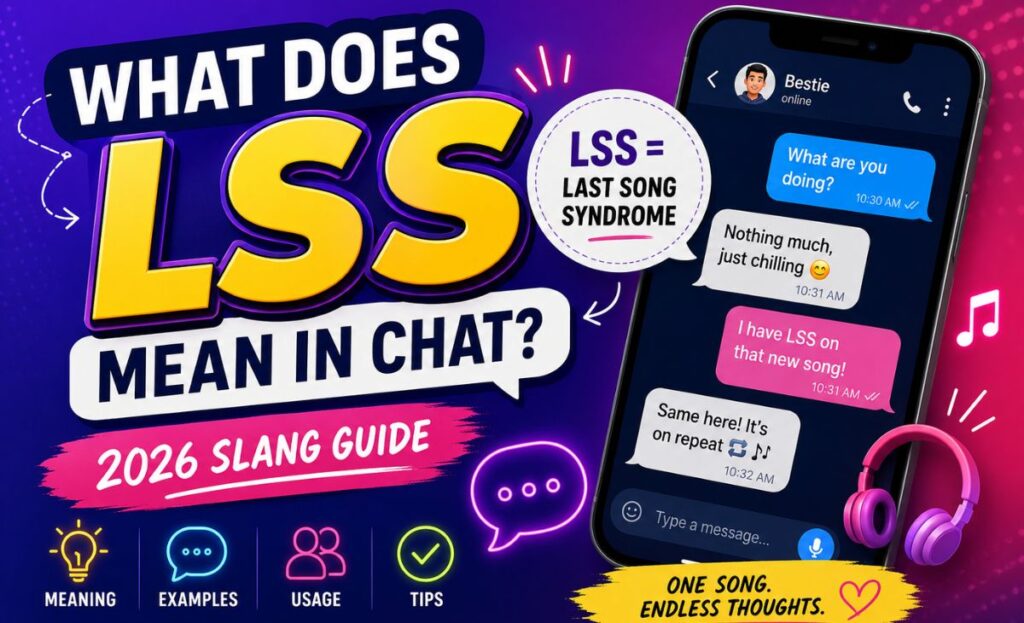
The most common lss meaning in chat is:
| Abbreviation | Meaning | Common Usage |
| LSS | Like, Share, Subscribe | Social media, YouTube, TikTok |
| LSS | Last Song Syndrome | Music conversations |
Simple Definition
When someone types “LSS,” they are usually asking others to:
- Like their content
- Share it with others
- Subscribe or follow their page
Quick Example
TikTok Comment:
“New edit just dropped 🔥 LSS please!”
This means the creator wants viewers to support the content.
Secondary Meaning: Last Song Syndrome
In music communities, lss meaning song refers to a catchy song that keeps replaying in your mind.
Example:
“That track gave me major LSS today.”
Here, LSS means the song is stuck in someone’s head.
Because internet slang evolves quickly, both meanings still exist in 2026.
Origin and History of LSS
Where Did LSS Come From?
LSS didn’t emerge from Western internet culture it actually has its roots in Filipino online communities, where the phrase Last Song Syndrome was already a popular expression in everyday conversation. In Filipino culture, describing that maddening loop of a catchy song stuck in your mind was so common that people naturally shortened it to LSS for convenience in texts and chats.
The underlying psychological phenomenon, however, has been studied globally for decades. Scientists call it an earworm (or Involuntary Musical Imagery INMI), and researchers first began examining why certain melodies get trapped in human cognition back in the 1990s. Studies suggest that earworms affect up to 98% of the population at some point, with most people experiencing them at least once a week. Songs with simple, repetitive structures think nursery rhymes, pop hooks, or viral TikTok sounds are the most common culprits.
How LSS Spread to Global Chat Culture
| Era | Platform | How LSS Was Used |
| Early 2000s | MSN Messenger, MySpace | Casual text shorthand among Filipino users |
| 2010s | Facebook, Twitter, Tumblr | Spread across Southeast Asia and diaspora communities |
| Late 2010s | Instagram, WhatsApp | Adopted by Gen Z internationally |
| 2020–present | TikTok, Discord, Snapchat | Global mainstream slang tied to viral songs |
By the time TikTok exploded into a global phenomenon, LSS had a perfect breeding ground. The platform’s endless autoplay format practically manufactures Last Song Syndrome on demand you watch a clip, a hook plays for 15 seconds, and suddenly you’re humming it at 2 AM against your will.
The LSS meaning also got a cultural boost in 2019 when the Philippines released a full-length film titled LSS (Last Song Syndrome), a romantic drama centered around music and connection. The film’s success reinforced the term’s place in pop culture and pushed it further into mainstream digital conversation.
How to Use LSS in Chat: Examples & Dialogues
Basic Usage
Using LSS in conversation is straightforward. You drop it when a song has taken over your brain simple as that. It works as a noun, a verb phrase, and even a standalone exclamation.
As a noun:
“I’ve had serious LSS since that café was playing Sabrina Carpenter all morning.”
As a verb phrase (common in Filipino-influenced English):
“Na-LSS ako sa that new Billie Eilish track.” (I got LSS from that new Billie Eilish track.)
As a standalone reaction:
Person A: sends a 15-second clip of a catchy song Person B: “NOOO why did you send that, LSS na ako 💀”
Real Chat Dialogues (2026 Updated)
Dialogue 1 — Group Chat
Maya: guys that sabrina carpenter song has been in my head since YESTERDAY Riya: omg same, full LSS Jake: which one? they’re all earworms lmao Maya: the new one from her album 😭 send help
Dialogue 2 — WhatsApp DM
Carlos: I heard that Coldplay x BTS collab at the gym this morning Priya: lol and now? Carlos: LSS. Can’t stop. Won’t stop. Priya: 😂 that’s your problem for going to the gym
Dialogue 3 — TikTok Comment Section
@user1: why does this sound play every 3 videos @user2: because the algorithm WANTS you to have LSS @user3: too late. it worked on me
Dialogue 4 — Discord Server
Nate: okay who put that horror game OST in the background music channel Zoe: lol why Nate: I have LSS and it’s creepy. Not okay.
Personality Traits and Usage Context of LSS
Who Uses LSS?
LSS shows up most naturally among people who are emotionally engaged with music but honestly, that’s most of us. Here’s how the term tends to map onto different types of people and conversations:
Music enthusiasts use LSS constantly it’s basically their second language for describing new discoveries or obsessive replays.
Casual listeners often use it reactively, like after hearing a viral TikTok sound that just won’t quit.
Content creators use it intentionally. Saying “this song will give you LSS” in a caption is essentially a compliment and a hook it implies the track is so good it’s inescapable.
Nostalgic users apply it retroactively “I have LSS from a song I heard ten years ago and just rediscovered.”
When Is It Appropriate to Use LSS?
LSS is informal slang, it belongs in casual conversations, social media captions, comment sections, and friend group chats. It has no place in a formal work email or a professional presentation. Context matters.
| Appropriate | Not Appropriate |
| Group chats with friends | Work Slack channels (unless your team is very casual) |
| TikTok/Instagram comments | Formal emails or reports |
| Music-related Discord servers | Academic writing |
| WhatsApp family/friend groups | Professional cover letters |
Common Mistakes or Misconceptions
Mistake #1: Thinking LSS Only Has One Meaning
The LSS meaning in chat is most commonly Last Song Syndrome, but the acronym carries different meanings in other contexts. In professional or corporate settings, LSS often refers to Lean Six Sigma — a process improvement methodology. In medical literature, it can mean Lumbar Spinal Stenosis or Life Support System. If you text “LSS” to a coworker without context, expect confusion.
Mistake #2: Using It for Any Kind of Repetition
LSS is specifically about music stuck in your head. It doesn’t apply to a quote, a sound effect, or a movie line replaying mentally. Using it outside the musical context might confuse people who know the term well.
Mistake #3: Confusing LSS with “Like, Share, Subscribe”
Some content creators particularly on YouTube use LSS as shorthand for Like, Share, Subscribe. This is an entirely separate usage, popular in creator-audience interactions. If someone ends a video with “Don’t forget to LSS!” they’re not talking about earworms, they’re asking for engagement.
Mistake #4: Assuming Everyone Knows the Term
LSS remains more widely recognized in Filipino communities and among heavy social media users. Older relatives or people less plugged into TikTok culture may have no idea what you mean. When in doubt, spell it out.
Mistake #5: Overusing It Until It Loses Meaning
Like any slang, LSS lands best when it’s genuine. Using it for every song you hear, whether or not it’s actually stuck in your head, makes the expression feel hollow. Reserve it for when a track genuinely won’t let you go.
Modern & Relatable Examples (2026 Updated)
Music culture in 2026 is faster and more saturated than ever. TikTok’s sound library, Spotify’s algorithmic playlists, and viral YouTube Shorts all feed the LSS machine daily. Here’s how the term is showing up in real-life digital scenarios right now:
Scenario 1 — The Reel That Ruined Your Morning You’re scrolling before breakfast. A 7-second clip plays with an insanely catchy hook. By the time you’ve poured your coffee, the chorus is on loop in your skull. You text your best friend: “I have LSS from a reel I watched for literally 3 seconds. This is a crime.”
Scenario 2 — Gym Playlist Victim A song comes on shuffle during your workout. It’s from 2019. You hadn’t thought about it in years. Somehow it’s back full LSS, full force. You add it back to your current playlist just to feel in control of the situation.
Scenario 3 — The Viral Sound You Can’t Escape There’s always that TikTok sound of the season. In 2026, fans and creators alike flood comment sections with “LSS 😭” under trending audio clips, making the term practically synonymous with virality itself.
Scenario 4 — The Ad Jingle Offender A streaming service’s ad plays the same 10-second jingle four times in a row. You weren’t even paying attention, but now the LSS is real and it’s infuriating. You consider whether premium subscriptions are worth it purely to protect your mental health.
Scenario 5 — LSS as a Compliment Someone shares their own song or cover in a server. Replies flood in: “Instant LSS, good luck to everyone’s brain today.” In this context, LSS has evolved into a genuine form of praise a signal that the music is undeniably catchy.
Quick Reference: LSS in a Nutshell
| Feature | Details |
| Full form | Last Song Syndrome |
| Also known as | Earworm, Stuck Song Syndrome, INMI |
| Origin | Filipino online and chat culture |
| Mainstream rise | TikTok era (2018–present) |
| Primary usage | Informal chat, social media, comments |
| Part of speech | Noun / informal verb phrase |
| Related slang | “I can’t get this out of my head,” “on repeat,” “obsessed” |
| Alternative meaning (unrelated) | Like, Share, Subscribe (creator context); Lean Six Sigma (business) |
| Mood conveyed | Relatable frustration, playful obsession, musical appreciation |
Top 5 Tips to Avoid Misusing LSS
1. Match Your Audience
Before dropping LSS into a conversation, quickly gauge whether the other person is likely to understand it. With close friends, online communities, and fellow music fans? Go for it. With someone’s mum or a formal work contact? Type it out instead.
2. Keep It in the Music Lane
Remember that LSS meaning is specifically tied to music. Don’t stretch it to cover other kinds of repetitive thoughts or mental loops. If a phrase from a movie is stuck in your head, that’s not LSS that’s just a quote you can’t shake.
3. Don’t Force It for Content
If you’re a creator using “this will give you LSS” as a caption hook, make sure the music actually delivers. Using LSS as clickbait when the song isn’t genuinely catchy damages trust with your audience.
4. Context-Check Before Sending
The same three letters mean very different things in a musician’s Discord vs. a business management forum. Before using LSS, consider whether the context makes the meaning clear or if you need to add a brief explanation.
5. Use It Genuinely, Not Compulsively
The best slang feels natural and authentic. If you actually have a song stuck in your head, LSS communicates that experience instantly and relatably. Use it for real moments, and it’ll always land well.
Frequently Asked Questions (FAQs)
What does LSS mean in chat?
LSS means Last Song Syndrome when a song gets involuntarily stuck in your head and keeps replaying, often after you’ve heard it once or twice.
What is the LSS meaning in a song context?
In a song context, LSS describes a track so catchy it refuses to leave your mind. Fans use it as a compliment, meaning the song is a certified earworm worth obsessing over.
Is LSS the same as an earworm?
Yes, LSS and earworm refer to the same experience. LSS is the informal chat-friendly slang version, while “earworm” is the more widely used English term, especially in psychological literature.
Where did LSS originally come from?
LSS originated in Filipino digital culture, where Last Song Syndrome was already a popular phrase before being shortened for use in texting and online chats.
Can LSS mean something else in different contexts?
Yes. In business, LSS can mean Lean Six Sigma. In creator communities, it sometimes stands for Like, Share, Subscribe. Always check the context when in doubt.
How do you respond when someone says they have LSS?
Just vibe with it. Ask which song, share if you’ve had the same experience, or send them a different track to overwrite it. Shared LSS is one of the great bonding moments of music fandom.
Is LSS a positive or negative thing?
Both can be delightfully obsessive (“I love this song so much, full LSS”) or mildly frustrating (“this ad jingle is giving me unwanted LSS”). The tone depends entirely on context.
Conclusion
The LSS meaning in chat is simple at its core: a song has hijacked your brain and set up camp. But the way this three-letter acronym has traveled from Filipino text culture to global TikTok comment sections says something bigger about how music and digital communication have fused. LSS captures a universal human experience (the earworm) in the most casual, shareable way possible.
Whether you’re texting a friend about your latest musical obsession, reading comment sections on the latest viral sound, or exploring LSS meaning in song culture as a creator, understanding this slang makes you a more fluent participant in modern online conversation.
The next time a track refuses to leave your head and it will you know exactly what to call it. LSS, full stop.

I am David Smith, a passionate blogger and skilled writer. I create clear, engaging, and high-quality content on different topics. I focus on delivering useful and easy-to-understand articles for my readers.