
You’re scrolling through TikTok comments, someone drops “I clocked that 👀,” and suddenly you’re staring at your screen wondering, wait, what does clock mean exactly? Is it an insult? A compliment? A meme? If you’ve been confused by this phrase, you’re not alone. Millions of people search for the clock it meaning every month, and for good reason, it’s one of those modern expressions that looks deceptively simple but carries layers of meaning depending on who says it, how they say it, and where.
In this guide, you’ll get a clear, no-fluff breakdown of what clock it means in text, slang, and social media including its real cultural origins, how to use it correctly, and when to leave it alone.
Clock It Meaning: Quick Definition
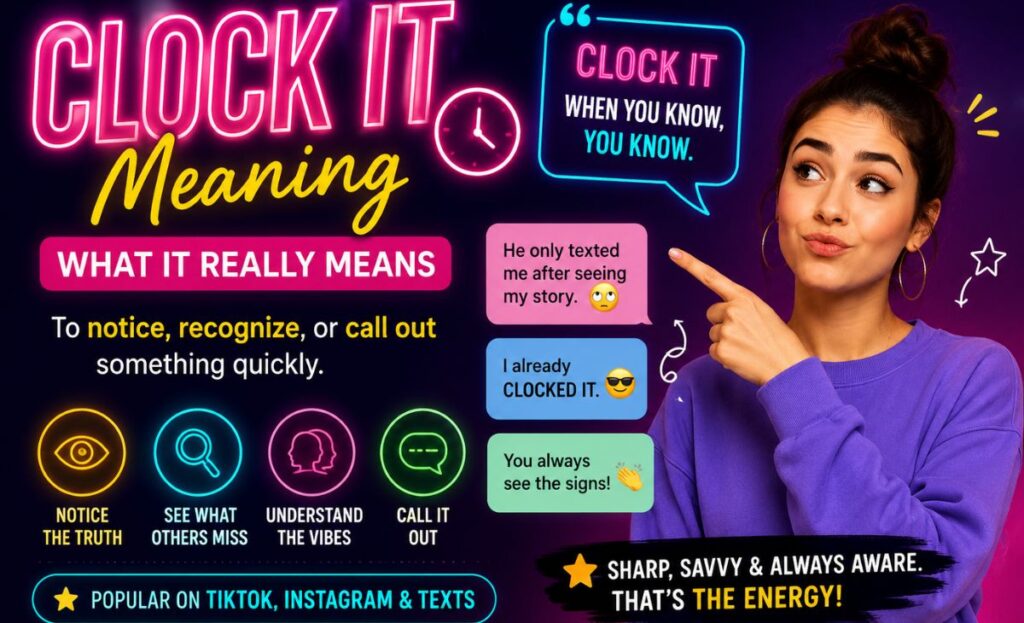
At its core, clock it means to notice, recognize, or call out something, often something subtle, suspicious, or hidden in plain sight. It signals sharp awareness. When someone says “I clocked that,” they’re essentially saying: I saw what you did. I caught that. I’m onto it.
What does clock it mean in a sentence?
“She thought nobody noticed, but we all clocked it immediately.”
“Clock it, he’s been acting differently all week.”
“That move was so obvious. Clock it, sis.”
The phrase goes beyond simply “seeing” something. It carries an edge of perception, the kind that implies you weren’t fooled, you paid attention, and you’re sharp enough to recognize what others might have missed. That’s exactly what makes it feel powerful in casual conversation and online spaces.
Origin & Background
To really understand what clock it means in slang, you have to go back to its roots and those roots run deep.
The Ballroom Scene: Where It All Began
The phrase “clock” in this social sense originated within Black and Latinx LGBTQ+ ballroom culture in New York City during the mid-to-late 20th century. Ballroom culture was a creative, community-driven world where people competed in performance categories ranging from fashion to vogueing. Within those spaces, language was both an art form and a survival tool.
In that context, “clocking” originally meant identifying a person’s gender identity or recognizing when someone’s “look” didn’t quite hold up essentially, seeing through an illusion. It was tied to the idea of “passing” in queer spaces, and clocking someone was a sharp, sometimes cutting act of recognition.
As one cultural commentator put it: “In ballroom culture, it was survival.” The language wasn’t casual, it was coded, protective, and deeply meaningful to the communities that created it.
From the Ballroom to Your Phone Screen
Over time, the phrase traveled through a well-known route that linguists call the “AAVE to Mainstream Pipeline.” It moved from ballroom floors to RuPaul’s Drag Race, then to Stan Twitter, and eventually exploded across TikTok and Instagram Reels where Gen Z adopted it freely.
By the early 2020s, “clock it” had become a go-to reaction phrase online, stripped of much of its original edge and softened into a general expression of noticing, affirming, or calling out something accurate. Today it functions as digital slang for nearly anyone who wants to signal sharp, confident awareness.
Real-Life Conversations
Seeing clock it in action makes its meaning click immediately. Here are some realistic examples across different situations:
Text Message Example
Alex: Did you see how he totally changed his answer when the teacher asked again? Jordan: Clock it. I caught that the first time he said it. Alex: Right? He thought nobody was paying attention.
Social Media Comment Example
(On a celebrity interview clip) User 1: She said she “never” knew about the deal… User 2: Clock it 👀 the receipts are right there in her own email.
Friend Group Chat
Maya: He said he wasn’t at the party but his location showed up in the background of three videos. Priya: Oh I clocked that immediately lmaooo
In each example, the phrase functions as a fast, punchy way to say: I noticed. I wasn’t fooled. I see the truth here.
Emotional & Psychological Meaning
There’s more going on with “clock it” than just noticing something. Psychologically, the phrase taps into some deeply human emotional drives.
1. The desire to be seen as perceptive. Saying “I clocked it” positions the speaker as sharp, observant, and socially awar someone who doesn’t miss things.
2. Validation of others’ observations. When you say “clock it!” in response to someone’s point, you’re affirming that their observation was accurate and worth noticing. It’s a social co-sign.
3. Controlled shade. In some contexts, clocking someone carries a mild edge of calling them out without a full confrontation. It acknowledges the truth without necessarily escalating it.
4. Community belonging. Using slang correctly signals membership in a cultural in-group. Dropping “clock it” at the right moment says: I get the culture. I’m in the know.
Understanding this layer helps explain why the phrase feels different from a plain word like “noticed” it carries emotional weight, attitude, and social positioning all at once.
Usage in Different Contexts
What does clock it mean slang can shift depending on where you encounter it. Here’s how it behaves across different environments:
| Context | How “Clock It” Is Used | Example |
| TikTok Comments | Affirming a creator’s sharp observation | “Clock it! You called this out perfectly.” |
| Text Messages | Reacting to catching someone in a lie or pattern | “I clocked that weeks ago tbh” |
| Twitter / X | Calling out hypocrisy or hidden truth | “Clock it — the receipts don’t lie.” |
| Friend Groups | Sharing awareness about someone’s behavior | “Did you clock how she reacted when his name came up?” |
| LGBTQ+ Spaces | Deeper recognition of identity or performance | Used with more cultural precision and weight |
| Gaming / Discord | Noticing a play, strategy, or player behavior | “Chat clocked it — he was camping the whole round.” |
When NOT to Use It
Knowing the right moments to use “clock it” matters just as much as knowing what it means. Here are the situations where you should skip it:
Professional or formal settings — Emails, job interviews, academic writing, and business meetings are not the place. Using internet slang here undermines your credibility.
With people unfamiliar with the phrase — If your audience doesn’t understand Gen Z or online slang, the phrase creates confusion rather than connection.
To demean or publicly humiliate someone — There’s a difference between a witty observation and a targeted callout meant to embarrass. Sharp awareness shouldn’t be used as a weapon.
Out of cultural context — Given the phrase’s roots in Black and Latinx LGBTQ+ ballroom culture, using it carelessly or without understanding that history can come across as tone-deaf.
As a substitute for deeper understanding — “Clock it” signals quick recognition, not deep analysis. Don’t use it where you actually need to explain your reasoning.
Common Misunderstandings
Even frequent internet users sometimes get this one wrong. Here are the most common mix-ups:
Misunderstanding #1: “It means to literally watch something, like a clock.” No. The phrase has nothing to do with timepieces. It’s about sharp recognition, not watching the time.
Misunderstanding #2: “Clock it always means calling someone out aggressively.” Not quite. It can be affirmative (“You got that right clock it!”) or observational (“I clocked her reaction immediately”) without any confrontational intent.
Misunderstanding #3: “It’s the same as saying ‘see it’ or ‘look at it.'” Close, but not the same. “Clock it” implies a level of shrewd awareness or social intelligence that a plain “see it” doesn’t carry.
Misunderstanding #4: “The hand gesture IS ‘clock it.'” The viral tapping/pointing gesture seen on TikTok is often mislabeled. In actual ballroom culture, “clocking” didn’t come with a signature hand movement the gesture grew from social media interpretations, not the original culture.
Comparison Table
Here’s a quick look at how “clock it” compares to similar slang expressions:
| Slang Phrase | Meaning | Key Difference from “Clock It” |
| Peep it | Look at this / notice this | More about directing attention than showing you already noticed |
| Catch it | See or understand something | Less social edge; more neutral |
| Read someone | Pointedly criticize or expose | More directly critical and personal |
| Spill the tea | Share gossip or truth | About sharing, not just noticing |
| Cap / No cap | Lying / telling the truth | About honesty, not observation |
| Slay | Performing exceptionally well | Totally different; it’s about excellence |
| Bet | Agreement or affirmation | Used to confirm, not to recognize something |
Variations & Types
The core phrase branches into a few natural variations, each with a slightly different flavor:
“I clocked it” — Past tense; you already noticed. “I clocked that vibe the second she walked in.”
“Clock it!” — Imperative; telling someone else to notice. “Clock it — he literally contradicted himself twice.”
“Clocked him/her” — Directing the observation at a specific person. “She clocked him immediately.”
“Clock the tea” — Specifically about noticing gossip or truth. Closely tied to ballroom culture’s use of “tea” meaning truth or gossip.
“Clock it, sis” — Adding “sis” softens it into an affectionate nudge, popular in LGBTQ+ and female-friendship dynamics.
How to Respond When Someone Uses It
Getting “clock it” dropped in a conversation and not sure how to respond? Here are some natural reactions depending on context:
If they’re affirming your observation:
“Right?! I knew you’d catch that.”
“Exactly , glad someone else saw it.”
If they’re calling something out to you:
“I see it now, honestly.”
“Okay okay, I won’t lie that’s fair.”
If you’re not sure what they noticed:
“Wait, what did you clock exactly?”
“Fill me in what are we seeing here?”
The key is to match the energy. “Clock it” is casual and expressive, so your response should feel natural and conversational, not stiff.
Regional & Cultural Usage
“Clock it” is primarily an English-language internet expression, but its reach has gone global through social media.
United States: Most widespread usage, both in LGBTQ+ communities (where it carries cultural weight) and in mainstream Gen Z digital spaces.
United Kingdom: British slang already used “clock” to mean “notice” or “spot” (e.g., “I clocked him across the room”), so the phrase integrated naturally.
Australia & Canada: Common among younger, digitally active demographics through TikTok and Instagram influence.
Non-English-speaking countries: Appears in comment sections globally due to the international spread of American pop culture and English-language internet content, though it’s less organically used in everyday speech outside English-speaking regions.
Generational divide matters here too:
Gen Z: Uses it fluently and frequently
Millennials: Understand it and use it occasionally
Gen X and older: Often unfamiliar unless heavily online
Is It Safe for Kids?
This is a genuinely fair question for parents and educators. Here’s an honest breakdown:
On the surface: “Clock it” is not a vulgar, explicit, or inherently harmful phrase. There are no curse words involved, and its base meaning noticing something is entirely neutral.
The nuance: Like most slang, context determines impact. Used positively (“Clock it , that’s a great point!”), it’s completely harmless. Used to call out, mock, or expose a peer in a group setting, it can become a tool for social cruelty. For younger kids especially, the line between sharp observation and targeted humiliation can blur quickly.
What parents should know:
The phrase is widely used by tweens and teens on TikTok and in group chats
Its cultural roots in LGBTQ+ spaces are worth age-appropriate discussion
Open communication about how slang is used matters more than restricting the words themselves
Verdict: Generally safe, but context-aware guidance is always smart.
FAQ’s
What does “clock it” mean in text?
It means to notice or recognize something quickly, often with sharp awareness or a hint of calling it out.
What does “clock it mean” in slang?
In slang, it means to perceive something others might have missed, seeing a hidden truth, catching a lie, or affirming someone’s accurate observation.
Is “clock it” positive or negative?
It depends on the tone. It can be affirming (“You’re right clock it!”) or carry subtle shade when used to expose someone.
Where did “clock it” originally come from?
It originated in Black and Latinx LGBTQ+ ballroom culture in New York, where it meant recognizing someone’s true identity or seeing through a performance.
Is “clock it” the same as “read someone”?
Not exactly. “Reading” someone is more directly critical. “Clocking” is more about recognition — sometimes silent, sometimes public.
Can adults use “clock it”?
Yes, but it reads most naturally in casual, digital, or informal settings. Avoid it in professional or formal contexts.
Conclusion
The modern clock it meaning goes far beyond simple internet slang. Today, the phrase represents awareness, quick observation, and social understanding.
Whether someone is exposing fake behavior, spotting hidden motives, or agreeing with a sharp comment, saying “clock it” is a fast and expressive way to acknowledge the truth.
As social media continues shaping language, phrases like this spread quickly across platforms like TikTok, Instagram, and X. Still, understanding the cultural roots behind the phrase helps people use it more respectfully and naturally.
So the next time someone says:
“Clock it.”
You’ll know exactly what they mean.

I am David Smith, a passionate blogger and skilled writer. I create clear, engaging, and high-quality content on different topics. I focus on delivering useful and easy-to-understand articles for my readers.