

If you have ever received a message with “JSP” and instantly felt confused, you are not alone. Internet slang changes fast, and new abbreviations appear every day across TikTok, Snapchat, Instagram, WhatsApp, Discord, and text messages.
Many people search questions like “what does JSP mean,” “what does JSP mean in text,” “jsp meaning text,” and “what does JSP mean in slang” because the meaning can change depending on the conversation.
In most casual texting situations, JSP usually means “Just Playing” or “Just Saying.” People use it to soften a joke, make a playful comment, express an opinion, or avoid sounding too serious.
This guide explains the real JSP meaning in text, where the slang came from, how people actually use it in conversations, emotional meanings behind it, common misunderstandings, and how you should respond when someone sends it.
JSP Meaning in Text – Quick Definition
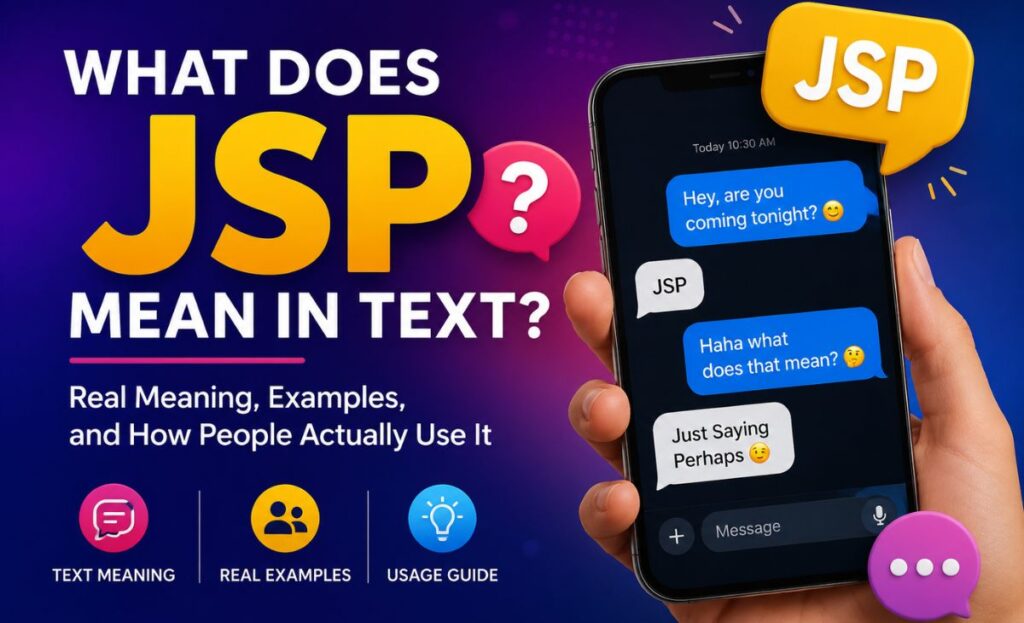
JSP in text most commonly stands for one of four things, depending on who’s typing it and where:
- Just Playing — the most casual use, signaling a joke or light tease
- Just Saying, Period — a confident, firm emphasis on a strong opinion
- Just Stop Playing — a call to cut the games and get serious
- Just Saying, Peace — a polite, laid-back closer to an opinion or statement
So what does JSP mean in slang, exactly? At its simplest: it’s a tone-setting abbreviation. It tells the reader how to receive the message playfully, firmly, seriously, or casually. Context is what unlocks the correct meaning every single time.
Quick answer for featured snippets: JSP in text means “Just Playing,” “Just Saying Period,” or “Just Stop Playing,” depending on context. It’s used to soften jokes, add emphasis to opinions, or tell someone to stop being dismissive or dishonest.
Origin and Background of JSP
How JSP Evolved as Digital Slang
Slang doesn’t get invented in a boardroom. It grows out of real conversations street talk, group chats, comment sections and JSP is no different.
The “Just Playing” version follows a pattern that’s been around forever. Long before texting existed, people would say something bold, get a reaction, then quickly add “just playing!” to dial back the tension. When SMS culture took hold and full phrases became inconvenient to type, abbreviations like “jp” and eventually “jsp” (with the added “s” for stylistic flair that stuck organically) became common shorthand.
The “Just Saying, Period” interpretation gained momentum alongside phrases like “periodt” and “and that’s on period” a Gen Z and millennial trend of punctuating opinions with finality. Adding “period” to “just saying” turned a mild observation into a mic drop.
The “Just Stop Playing” Roots
The Just Stop Playing meaning has distinct cultural roots. As noted by several slang researchers, this version emerged from African American Vernacular English (AAVE) and Black internet culture the same communities that shaped expressions like “no cap,” “on God,” and “stop playing with me.” The phrase “stop playing” has been used in AAVE for decades to mean: stop joking, stop being fake, stop wasting my time.
As platforms like Twitter, Snapchat, and TikTok compressed language further, “just stop playing” became “JSP.” By the early 2020s, it had crossed into mainstream usage and spread well beyond its original community.
The Technical Side Note
Worth mentioning: in programming, JSP stands for JavaServer Pages — a web technology introduced by Sun Microsystems in 1999. If you see “JSP” in a developer forum or coding tutorial, it has absolutely nothing to do with texting slang. The two worlds simply don’t intersect.
Real-Life Conversations Using JSP
This section matters most. Definitions are useful, but examples are how slang actually sticks.
Example 1 – Just Playing (Casual Teasing)
Alex: You looked so tired today, like genuinely rough 😭
Sam: JSP bro, you’re still my favorite person 💀
Here, JSP walks back a potentially harsh comment. It signals: “I’m messing with you, don’t take offense.”
Example 2 – Just Saying, Period (Strong Opinion)
Maya: That new restaurant downtown is mid at best. JSP.
Jordan: Okay wow, tell us how you really feel 😂
JSP at the end lands like a full stop. Maya isn’t inviting debate she’s dropping her verdict and walking away.
Example 3 – Just Stop Playing (Serious Tone)
Riley: Okay but are you actually mad at me or nah?
Chris: JSP, yeah I am. That was a messed up thing to do.
In this case, JSP signals that Chris is done joking. The playfulness is gone this is a real conversation now.
Example 4 – Just Saying, Peace (Friendly Exit)
Taylor: Honestly the vibe was off tonight but whatever, JSP ✌️
Jamie: Lol I felt it too
This version softens the criticism and ends it gently no drama, no invitation to argue.
Emotional and Psychological Meaning
Why People Use JSP (and What It Really Signals)
Text messages strip out tone of voice, facial expressions, and body language the three things humans rely on most to understand intent. JSP fills that gap.
When someone uses JSP as “Just Playing,” they’re using what linguists call tone-softening language a verbal safety net that converts a potentially hurtful remark into a joke. It’s the text equivalent of saying something bold and then adding a laugh to let the other person know: no harm meant.
When someone uses JSP as “Just Stop Playing,” the psychology flips. It communicates emotional directness a refusal to let vagueness slide. People reach for this version when they’ve been patient enough and want clarity without a lengthy explanation.
The common thread across all uses? JSP gives the sender control over how their message lands. That’s why it’s so popular in digital spaces where tone is ambiguous by default.
Usage in Different Contexts
Social Media (TikTok, Instagram, Snapchat, Twitter/X)
JSP thrives in informal digital spaces. On TikTok, it shows up in comment sections responding to dramatic claims. On Snapchat and Instagram DMs, it softens teasing between friends. On Twitter/X, the “Just Saying, Period” version often closes a hot take thread.
Texting and Direct Messages
This is JSP’s home turf. Between close friends or romantic partners, all four versions are common. The key is reading the surrounding conversation, a playful chat favors “Just Playing,” while a tense exchange hints toward “Just Stop Playing.”
Romantic Conversations
In flirtatious or relationship contexts, JSP often works as a softener. Someone might confess feelings, then add “jsp” to avoid vulnerability if the response doesn’t land. It’s a small emotional buffer.
Professional Settings
JSP has essentially no place in professional communication emails, Slack with coworkers, formal reports. It belongs to casual, informal speech. Using it in a work context would create confusion at best, unprofessionalism at worst.
Common Misunderstandings
“JSP Always Means the Same Thing”
It doesn’t. This is the most common mistake. Without reading the tone and context of the full message, picking the wrong meaning of JSP can cause real confusion or worse, a misread emotional moment.
“JSP is the Same as JK”
They’re related, but not identical. “JK” (just kidding) is almost exclusively used to walk back a joke. JSP is more versatile it can soften, emphasize, or confront depending on how it’s deployed.
“It’s Always Aggressive”
The “Just Stop Playing” meaning can carry edge, but it’s not inherently hostile. Between close friends, it can be playful. Between people in conflict, it signals seriousness. Tone determines everything.
“It Only Has One Correct Definition”
Because JSP emerged organically across different online communities, multiple definitions coexist and are all “correct” in their own context. There’s no official authority that declared one meaning official.
Comparison Table
| Abbreviation | Full Form | Tone | Best Used When |
| JSP | Just Playing | Playful, light | Walking back a tease or joke |
| JSP | Just Saying, Period | Confident, firm | Emphasizing a strong opinion |
| JSP | Just Stop Playing | Direct, serious | Asking someone to be real |
| JSP | Just Saying, Peace | Casual, gentle | Ending a mild take softly |
| JK | Just Kidding | Humorous | Walking back a joke |
| JS | Just Saying | Neutral, mild | Sharing a passive opinion |
| NGL | Not Gonna Lie | Honest, blunt | Admitting something real |
| IMO | In My Opinion | Subjective | Sharing a personal view |
Variations and Types of JSP
“I’m JSP” or “Im jsp”
One of the most searched variations online, “I’m JSP” typically means “I’m just stop playing” in other words, “I’m being completely serious right now.” It’s used to draw a hard line between joking and real talk.
“Bro, im jsp, that actually happened.”
“I’m JSP, I need you to call me back.”
“JSP tho”
Adding “tho” (though) lightens the statement slightly it softens a bold take into something more conversational.
“That movie was overrated, jsp tho.”
Lowercase “jsp”
Lowercase signals a more casual, offhand use typically the “Just Playing” or “Just Saying, Peace” meaning. All-caps JSP can feel more pointed or serious in tone.
Emoji Pairings
JSP frequently appears with:
- 😂
- 😭
- 😅
- 🤣
- ☠️
These emojis help reinforce tone and prevent misunderstandings.
How to Respond When Someone Uses JSP
How you respond depends entirely on which version of JSP they used. Here’s a practical breakdown:
If they used JSP as “Just Playing”:
- Match the energy: laugh it off, reply with a joke back
- Use “jsp” yourself in your reply to keep the playful tone
- Add an emoji to signal you understood the joke
If they used JSP as “Just Saying, Period”:
- Acknowledge their opinion directly they’re not looking for pushback
- You can agree, disagree, or add “same, jsp” to co-sign
If they used JSP as “Just Stop Playing”:
- This is a signal to drop the deflection and be direct
- Avoid sarcasm or more jokes respond honestly
- A short, sincere reply works better than a long defensive one
If they used JSP as “Just Saying, Peace”:
- Keep it light and easy they’re not looking for a deep conversation
- A simple “lol same” or jsp” is a natural response
Regional and Cultural Usage
United States
JSP is most widely used in the US, particularly among Gen Z and younger millennials. The “Just Stop Playing” meaning has its strongest roots in urban communities and within AAVE-influenced internet culture. The “Just Saying, Period” version is broadly popular across different demographics.
United Kingdom
UK users are familiar with JSP primarily through TikTok and Twitter/X. The phrase “stop playing” doesn’t carry the same cultural weight as it does in AAVE contexts, so UK users more commonly interpret JSP as “Just Playing” or “Just Saying.”
India, Pakistan, and South Asia
As English-language social media use has grown significantly across South Asia, JSP has entered everyday digital conversations particularly among younger users on Instagram, WhatsApp, and Snapchat. It’s mostly used in the casual, tone-softening sense.
Australia and Canada
Recognized but less dominant. Users in these regions generally encounter JSP through imported internet culture and interpret it through context rather than community familiarity.
Cross-Cultural Note
Because JSP originated partly in AAVE culture, it’s worth approaching it with awareness. Using slang that emerged from a specific cultural community is common in the internet age, but understanding its roots adds respect to its use.
FAQ’s
What does JSP mean in text exactly?
JSP in text typically means “Just Playing,” “Just Saying, Period,” or “Just Stop Playing,” depending on the context and tone of the conversation.
What does JSP mean in slang on TikTok or Snapchat?
On TikTok and Snapchat, JSP most commonly means “Just Playing” (indicating a joke) or “Just Saying, Period” (adding confidence to a take or opinion).
Is JSP the same as JK?
Not exactly. JK (just kidding) is used almost exclusively to walk back jokes, while JSP is more versatile, it can soften, emphasize, or confront depending on context.
Can JSP be used seriously?
Yes. The “Just Stop Playing” version is used when someone wants to drop the humor and communicate something real or important.
Is JSP formal or informal?
JSP is entirely informal slang. It belongs in casual texting, DMs, and social media, not professional emails or formal writing.
Does JSP mean the same thing for everyone?
No. Different communities and age groups may interpret JSP differently. Reading the full context of a conversation is the most reliable way to understand which meaning applies.
Conclusion
So, what does JSP mean in text? The honest answer: it depends on who’s saying it, where, and why. That’s not a frustrating non-answer it’s actually what makes JSP such a useful piece of digital shorthand. Whether it’s softening a tease, punctuating a strong take, demanding realness, or signing off peacefully, JSP communicates tone in a world where tone is otherwise invisible.
Once you understand the four core interpretations Just Playing, Just Saying Period, Just Stop Playing, and Just Saying Peace you’ll catch the right meaning almost instantly from context. And now that you know the full story behind JSP meaning in text, you’ll never have to pause mid-chat and quietly Google it again.

I am David Smith, a passionate blogger and skilled writer. I create clear, engaging, and high-quality content on different topics. I focus on delivering useful and easy-to-understand articles for my readers.