

If you’ve recently seen ONB in a text message, TikTok comment, Snapchat chat, Instagram DM, or gaming conversation, you might be wondering: What does ONB mean in text?
Internet slang changes quickly, and new abbreviations appear almost every day. Among the many trending slang terms, ONB has become especially popular among Gen Z and social media users. While it looks simple, its meaning can vary depending on the context and conversation.
In most cases, ONB means “On Bro”, a phrase used to emphasize honesty, seriousness, or agreement. However, there are also a few alternative meanings that people use online.
This complete guide explains the ONB meaning in text, its origin, emotional impact, examples, variations, and when you should (or shouldn’t) use it.
ONB Meaning in Text – Quick Definition
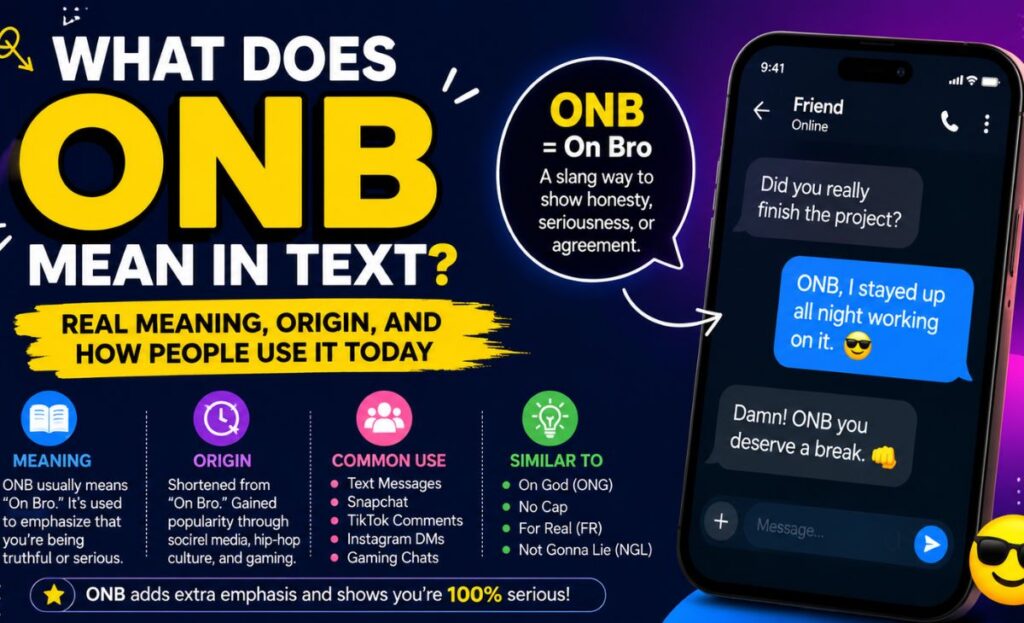
In most everyday conversations, ONB stands for “On Bro.” It’s a slang phrase people use to emphasize that they’re being completely honest or serious about something they just said.
Think of it as the texting version of phrases like:
- “I swear”
- “For real”
- “On God”
- “I’m not joking”
So when someone texts, “I’m quitting that gym, ONB,” they’re not asking for your opinion. They’re confirming that they mean it, no take-backs.
ONB is informal, casual, and mostly used between friends, on social apps, and in DMs, not in professional emails or formal writing.
Origin and Background of ONB
Like a lot of internet slang, ONB didn’t come from a dictionary. It grew naturally out of spoken phrases that people already used to swear honesty, like “on my brother” or “on bro.” Over time, as texting and social media made shorter messages the norm, people started shortening these phrases into quick acronyms.
The phrase has roots in casual, everyday speech patterns that were already common before texting took over, similar to how “I swear on my life” became “I swear” in shorter conversations. As platforms like Snapchat, TikTok, and Instagram grew, users needed faster ways to express emotion and sincerity without typing full sentences, and ONB filled that gap perfectly.
It’s worth noting that slang acronyms rarely have one single “official” creator. Instead, they spread because enough people start using them the same way, and ONB is a good example of that organic growth.
Real-Life Conversations Using ONB
Seeing ONB in context makes it much easier to understand. Here are a few examples of how it shows up in real texts and comments:
- Friend 1: “Bro that movie was actually insane” Friend 2: “ONB it had me shook the whole time”
- Text message: “I’m cleaning my whole room this weekend. ONB. No more excuses.”
- Group chat: “We’re getting food after practice, ONB I’m starving right now”
- TikTok comment: “This sound is so addictive ONB 😭”
In every case, ONB is doing the same job: adding weight to whatever was just said, almost like an exclamation point made of letters.
Emotional and Psychological Meaning
Beyond just being a shortcut, ONB carries emotional weight. When people use it, they’re signaling that the statement matters to them, even if the topic itself is small or silly.
Psychologically, this kind of emphasis acronym helps people:
- Sound more sincere in text, where tone can be hard to read
- Avoid sounding sarcastic when they’re being genuine
- Build a sense of closeness or trust with friends through shared slang
It’s a small word, but it does a lot of emotional heavy lifting. Saying “ONB” after a statement is like adding a verbal handshake, it tells the other person, “I mean this.”
Usage in Different Contexts
ONB can shift slightly depending on where and how it’s used. Here’s a quick breakdown:
In Casual Texting
This is where ONB feels most natural. It’s used between friends, partners, or family members to add sincerity to everyday messages.
On Social Media (TikTok, Instagram, Snapchat)
ONB often appears in comments or captions to react strongly to something, almost like saying “for real” in response to a video or post.
In Group Chats
Used to back up a plan or statement so the group takes it seriously, like confirming “yes, this is actually happening.”
In Professional or Formal Settings
ONB should generally be avoided here. It’s too casual for emails, client messages, or workplace communication, and could come across as unprofessional.
Common Misunderstandings
Because ONB is short and not officially documented anywhere, people often misread it. Some common mix-ups include:
- Confusing it with “Oh No, Baby”
Some people use ONB this way to express sympathy or concern, but it’s far less common than the “On Bro” meaning.
- Thinking it’s an abbreviation for a brand or system
In technical or banking contexts, ONB can stand for something completely different (like an online banking platform), so context matters.
- Assuming it’s always serious
While ONB emphasizes sincerity, it’s often used in lighthearted or funny situations too, not just emotional ones.
- Mixing it up with similar-looking acronyms
Terms like “OMB” or “ONG” look similar but carry different meanings.
The biggest takeaway: context is everything. The platform, the relationship between the people texting, and the tone of the message all help clarify what ONB means in that moment.
Comparison Table
| Acronym | Common Meaning | Typical Use Case |
| ONB | On Bro | Emphasizing honesty or seriousness |
| ONG | On God | Swearing something is true |
| FR | For Real | Confirming a statement is genuine |
| ICANT | I Can’t | Expressing disbelief or being overwhelmed |
| LFG | Let’s F***ing Go | Expressing excitement or hype |
| NGL | Not Gonna Lie | Admitting something honestly |
This table shows how ONB fits into a wider family of “honesty emphasis” slang that’s common across texting and social media today.
Variations of ONB (Types and Meanings)
While “On Bro” is the most widely recognized meaning, ONB does have a few less common variations depending on who’s using it:
- On Bro – The dominant meaning; used to swear honesty or seriousness.
- Oh No, Bro/Babe – Used as a reaction to bad news, awkward situations, or something disappointing.
- On My Baby – A more affectionate version, often used between couples or close friends to emphasize a promise.
- Only No Beef – A rarer, playful version meaning there’s no conflict or bad feelings.
If you’re unsure which one applies, look at the relationship between the people texting and the tone of the rest of the conversation. In nearly all everyday cases, “On Bro” is the safest interpretation.
How to Respond When Someone Uses ONB
Not sure how to reply when someone drops ONB in a chat? Here are a few natural responses depending on the situation:
- If they’re confirming a plan: “Bet, ONB let’s do it”
- If they’re being serious about something emotional: “I hear you, that’s real”
- If it’s used playfully: “Lol okay ONB then 😂”
- If you’re unsure of the meaning: A simple “wait what do you mean by that?” works fine too
The key is matching their energy. If someone uses ONB to emphasize a point, responding with agreement or acknowledgment keeps the conversation flowing naturally.
Regional and Cultural Usage
ONB is most common in casual American English, especially among Gen Z and younger Gen Alpha users. It has strong ties to internet culture, hip-hop influenced slang, and social media speech patterns.
That said, slang spreads fast across borders thanks to platforms like TikTok and Instagram, so it’s increasingly common to see ONB used by English speakers outside the U.S. as well, particularly younger users who consume a lot of American content online.
It’s not unusual for the same acronym to mean slightly different things depending on the country, age group, or even the specific app being used, so paying attention to how people around you use it is the best way to stay accurate.
Real-Life Experience Insight
Anyone who spends time in group chats or comment sections has likely seen ONB pop up without warning. The first reaction is usually confusion, followed by a quick search or a casual “what does that mean?” to a friend.
What’s interesting is that once people learn the meaning, they tend to start using it themselves almost immediately, because it fits naturally into how people already talk. It’s not a forced or awkward addition to texting vocabulary; it slots right into existing habits of adding emphasis to statements.
This kind of organic adoption is exactly why ONB has stuck around while so many other short-lived slang terms fade out within a few months.
When You Should Use ONB
ONB works best in situations like:
- Texting close friends or family casually
- Reacting to videos, memes, or posts on social media
- Confirming plans or promises in a lighthearted way
- Adding emphasis to something funny, exciting, or surprising
On the other hand, avoid using ONB:
- In professional emails or workplace chats
- When messaging someone who may not be familiar with slang
- In serious or sensitive conversations where clarity matters more than tone
When in doubt, save ONB for relaxed, informal conversations where a little extra emphasis adds personality without causing confusion.
Why ONB Became So Popular
ONB caught on for a few simple reasons. First, it’s short and easy to type, which matters a lot in fast-moving conversations. Second, it fills a real gap: texting often strips away tone, so phrases like ONB help convey sincerity that would otherwise be lost.
Third, platforms like TikTok and Snapchat reward quick, punchy language, and ONB fits perfectly into comment sections and captions where space and attention spans are limited.
Finally, slang spreads through repetition and community use. Once enough people start using a term the same way, it becomes part of shared digital language, and ONB has clearly reached that stage.
FAQ’s
What does ONB mean in a text message?
ONB most commonly means “On Bro,” a slang phrase used to emphasize that someone is being honest or serious.
Is ONB only used by younger people?
It’s most popular among Gen Z and younger users, but it’s increasingly used by people of all ages who are active on social media.
Can ONB mean something other than “On Bro”?
Yes, in some cases it can mean “Oh No, Bro/Babe” or “On My Baby,” depending on the tone and relationship between the people texting.
Is it okay to use ONB in professional messages?
No, ONB is informal slang and should be avoided in emails, client communication, or workplace chats.
How do I reply when someone texts me ONB?
You can simply acknowledge it with agreement, like “okay, I trust you” or respond casually depending on the context of the conversation.
Where did ONB come from?
ONB likely developed from spoken phrases like “on my brother” or “on bro,” which were shortened for texting and social media use.
Conclusion
The ONB meaning in text is usually “On Bro,” a popular slang phrase used to show honesty, seriousness, trust, and strong agreement. It functions similarly to phrases like “I swear,” “No Cap,” and “On God.”
Although ONB can occasionally mean other things such as Outward Nose Breath or On Board, context almost always reveals the intended meaning.
As texting culture continues to evolve, abbreviations like ONB remain popular because they’re short, expressive, and emotionally powerful. If you see someone type “ONB” in a chat, comment section, or DM, chances are they’re simply emphasizing that they’re being genuine, truthful, or completely serious.

I am David Smith, a passionate blogger and skilled writer. I create clear, engaging, and high-quality content on different topics. I focus on delivering useful and easy-to-understand articles for my readers.