
Have you ever seen “WLW” pop up in a text message, TikTok caption, or Instagram bio and thought, what does that even mean? You’re not the only one. Internet slang moves fast, and three-letter terms like this one can leave even the most online people scratching their heads.
Don’t worry. By the end of this article, you’ll know exactly what WLW means, where it came from, how people use it in real conversations, and what to say when someone uses it around you. Simple, clear, and no confusing jargon, even a 10-year-old can understand this.
WLW – Quick Meaning
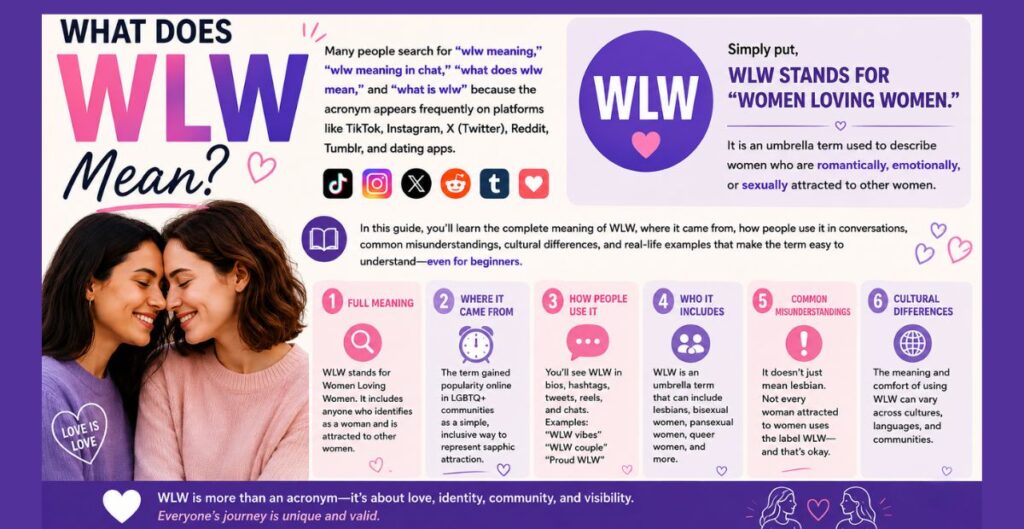
WLW stands for “Women Loving Women.”
It is a short, respectful term used to describe women who feel romantic, emotional, or physical attraction toward other women. When someone writes “I’m WLW” in a chat or puts it in their bio, they’re saying that they are a woman who is attracted to women, without needing to use a more specific label.
| Term | Full Form | What It Describes |
| WLW | Women Loving Women | Women attracted to other women |
| MLM | Men Loving Men | Men attracted to other men |
| Sapphic | From poet Sappho | Women/non-binary attracted to women |
| LGBTQ+ | Lesbian, Gay, Bisexual, Trans, Queer | Broader umbrella community |
Unlike more specific labels, WLW is an umbrella term, it covers lesbians, bisexual women, pansexual women, queer women, and anyone else who is a woman attracted to women.
Origin & Background
The term WLW didn’t appear overnight. Its roots trace back to early online LGBTQ+ communities in the late 1990s and early 2000s, when internet forums and chat rooms became safe spaces for queer people to connect and share their experiences.
As social media grew, short and inclusive terms became necessary. Typing out “women who are romantically and emotionally attracted to other women” every time was simply not practical. WLW offered a clean, fast, and respectful shortcut.
Some researchers and community historians link the early use of the term to Black lesbian communities, where it was used as an empowering, non-clinical way to describe same-gender love among women. Over time, it spread across Tumblr, Twitter, TikTok, and eventually everyday texting.
Today, WLW is recognized globally, you’ll find it in dating app bios, fan fiction tags, social media hashtags, and yes, regular text conversations between friends.
Real-Life Conversations
Seeing how WLW actually gets used in everyday chats makes it much easier to understand. Here are some realistic examples:
Example 1 – Casual texting
Mia: “Hey, are you seeing anyone?” Zara: “Not yet lol, I’m WLW so dating apps are a little extra 😅”
Example 2 – Social media bio
Emma’s Instagram bio: “📍London | 🎨 Artist | WLW 🏳️🌈”
Example 3 – Group chat
Lily: “Anyone know good WLW films to watch this weekend?” Sofia: “Yes!! Watch ‘Portrait of a Lady on Fire’, it’s beautiful”
Example 4 – Online community
“Looking for WLW friends who love K-dramas and poetry 💕”
Example 5 – Coming out context
Hana: “I’ve been figuring stuff out lately… I think I’m WLW” Friend: “I’m so proud of you for sharing that 💙”
In all of these examples, WLW is used naturally, sometimes casually, sometimes with real emotional weight. The meaning stays the same: a woman who loves women.
Emotional & Psychological Meaning
WLW is more than just internet shorthand. For many people, it carries deep personal significance.
Using WLW instead of a more specific label gives people room to explore their identity without pressure. Someone who isn’t ready to say “I’m a lesbian” or “I’m bisexual” might feel comfortable saying “I’m WLW”, and that’s perfectly valid.
Here’s what WLW often means emotionally:
- Safety, It’s a softer, less clinical way to come out or describe attraction
- Community, Using it signals belonging to a shared group with shared experiences
- Flexibility, It doesn’t lock anyone into one rigid box
- Pride, For many, saying or writing WLW is an act of self-affirmation
- Visibility, It helps women in same-gender relationships feel seen in conversations and media
Psychologists and LGBTQ+ counselors often note that having access to inclusive, flexible language helps people feel less isolated during identity exploration. WLW serves exactly that purpose.
Usage in Different Contexts
WLW appears in many different places online and offline. Here’s a breakdown:
Social Media (TikTok, Instagram, Twitter/X)
WLW is incredibly common as a hashtag (#WLW) and in bios. On TikTok especially, creators use it to categorize their content for queer women audiences. Searching #WLW on TikTok brings up millions of videos about relationships, lifestyle, coming-out stories, and more.
Dating Apps (Tinder, Hinge, Bumble)
Many users include WLW in their profile descriptions to signal their identity and the kind of connection they’re looking for, without writing a long explanation.
Group Chats & Text Messages
Friends use it casually when discussing crushes, relationships, or recommending shows. It saves time and feels natural within the community.
Fan Communities & Fiction
WLW is widely used in fan fiction and fan art communities to tag stories and artwork featuring female characters in romantic or emotional relationships.
Coming-Out Conversations
Some people use WLW as a gentle way to open up about their identity, especially in early conversations where they’re still figuring things out.
Key rule: Use WLW in contexts where attraction or identity is clear. Avoid using it to describe or label someone else without their consent. It’s a self-applied term, not a way to categorize others.
Common Misunderstandings
There are a few things people get wrong about WLW. Let’s clear them up:
Misconception 1: WLW only means lesbian Not true. WLW is broader. It includes lesbians, yes, but also bisexual women, pansexual women, queer women, and others. It is specifically designed to be inclusive.
Misconception 2: WLW is slang for something negative Absolutely not. WLW is a respectful, community-embraced term. It is not an insult and is not used mockingly in its intended context.
Misconception 3: Only young people use WLW While it’s popular among younger generations online, people of all ages within LGBTQ+ communities use and recognize WLW.
Misconception 4: WLW and Sapphic mean the exact same thing These two terms are closely related but have a subtle difference. WLW typically refers to women, while “Sapphic” can also include non-binary people who experience attraction to women, making Sapphic slightly broader in some communities.
Misconception 5: You have to be 100% sure of your identity to use WLW Wrong. WLW is often used by people who are still exploring and questioning. That’s one reason the term exists, to give people flexible, low-pressure language.
Variations / Types of WLW (8+)
WLW is an umbrella, and underneath it are many specific identities. Here’s a clear breakdown:
| Type | Description |
| Lesbian | A woman exclusively attracted to other women |
| Bisexual WLW | A woman attracted to both women and other genders |
| Pansexual WLW | Attracted to people regardless of gender, including women |
| Queer WLW | Uses “queer” as a broad self-identifier |
| Sapphic | Women/non-binary people attracted to women; slightly broader term |
| Demisexual WLW | Only experiences attraction after forming a deep emotional bond |
| Aromantic WLW | Experiences little or no romantic attraction, but may be sexually attracted to women |
| Questioning WLW | Exploring whether they are attracted to women; not yet using a firm label |
| NBLW | Non-binary people attracted to women, a WLW variant |
| WLNB | Women attracted to non-binary people, another variation in the same family |
Every single one of these identities is valid. The beauty of WLW as an umbrella term is that none of these people have to choose between labels, they can simply say WLW and be understood.
How to Respond When Someone Uses It
Whether a friend tells you they’re WLW or you see it in someone’s bio, here’s how to respond in a way that’s kind and respectful:
If a friend tells you they’re WLW:
- Simply acknowledge it with warmth: “Thanks for sharing that with me 💙”
- Don’t make it a bigger deal than they want it to be
- Don’t ask overly personal questions unless they bring it up
- Continue treating them exactly as you always have
If you see it in a social media bio:
- It’s just a piece of identity information, no different from someone listing their hometown
- No need to comment on it unless you’re engaging with their content genuinely
What NOT to do:
- Don’t ask “So does that mean you like me?”, that’s uncomfortable
- Don’t share the information with others without permission
- Don’t assume anything about their relationship status or preferences
The simplest and best response? Respect it and move on naturally. That’s what genuine allyship looks like.
Regional & Cultural Usage
WLW is primarily an English-language term, but its reach has gone global thanks to social media.
- English-speaking countries (US, UK, Australia, Canada): Widely understood across all age groups active online
- Latin America: The term circulates in English within LGBTQ+ spaces, though local Spanish equivalents are also used
- East Asia (South Korea, Japan, China): WLW appears in international fan communities; locally, terms like “Girls’ Love” (GL) are more common
- South Asia: WLW is used within English-speaking urban LGBTQ+ communities; it’s less common in regional languages
- Europe: Widely recognized in LGBTQ+ online communities, especially among younger users
One important cultural note: In some communities, particularly among queer women of color, WLW is preferred over “lesbian” because it feels more inclusive and less burdened by historical exclusion. The term resonates differently depending on personal, cultural, and historical context.
Regardless of region, the core meaning stays the same: a woman who loves women.
FAQ’s
What does WLW mean in text?
WLW stands for “Women Loving Women.” It describes women who are romantically or emotionally attracted to other women.
What does WLW mean in chat on Snapchat or Instagram?
The meaning is the same across all platforms, Women Loving Women. It’s often used in bios or captions to express identity or community belonging.
Is WLW the same as lesbian?
Not exactly. WLW is a broader umbrella term that includes lesbians, bisexual women, pansexual women, and other identities. All lesbians can be WLW, but not all WLW are lesbians.
Can someone use WLW if they’re still figuring out their identity?
Absolutely. WLW is flexible and low-pressure, making it a popular choice for people who are questioning or exploring their identity.
What is the difference between WLW and Sapphic?
Both terms refer to women attracted to women. Sapphic is slightly broader as it can include non-binary people who are attracted to women.
Is WLW used only online?
It started online but has moved into everyday conversations. You’ll hear it in casual texting and friend groups, not just on social media.
What does WLW mean on TikTok?
On TikTok, WLW is both an identity descriptor and a content category. Videos tagged #WLW often feature stories, humor, and relatable content for queer women.
Conclusion
If you’ve been wondering what does WLW mean, the answer is straightforward: WLW stands for Women Loving Women. It is an inclusive term that describes women who experience romantic, emotional, or sexual attraction toward other women.
The term has become increasingly popular across social media, dating apps, online communities, books, movies, and everyday conversations. Understanding the WLW meaning in chat helps you navigate modern online communication while respecting how people describe their identities and experiences.
Whether you encounter WLW in a text message, social media bio, hashtag, dating profile, or discussion about representation, you’ll now understand exactly what it means and how it is used in real life.

I am David Smith, a passionate blogger and skilled writer. I create clear, engaging, and high-quality content on different topics. I focus on delivering useful and easy-to-understand articles for my readers.